INTERVIEW: How We'll Solve LG Salary Crises - Gov Ahmed
Your Excellency Sir, first we wish you a very happy
birthday and many happy returns. Thank you.
Can you describe for us what your background was
like, growing up?
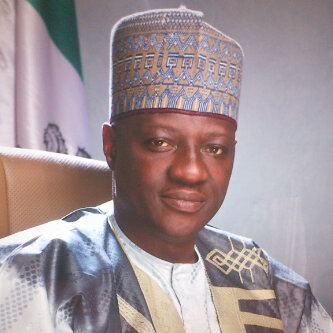 I was born in Kaduna and had my early
education there. Incidentally, my father was an instructor at Police College,
Kaduna. So I had the opportunity of growing up in a cosmopolitan environment. I
got quite exposed to almost every ethnic nationality in this country
I was born in Kaduna and had my early
education there. Incidentally, my father was an instructor at Police College,
Kaduna. So I had the opportunity of growing up in a cosmopolitan environment. I
got quite exposed to almost every ethnic nationality in this countryand I understood how to live in a cosmopolitan environment. That truly helped me as I was growing up, in meeting people, in getting to relate with people, and has truly helped me also in various areas I have worked. After leaving school, I had the opportunity of working as a teacher in the Northern part of the country, precisely in Sokoto, Federal School of Arts and Science. I have also had the opportunity of working in a bank where we got exposed to a lot of people, Nigerians, non-Nigerians, people from all walks of life. So growing up in a cosmopolitan environment truly helped me to interact with customers and also helped me to build the necessary skills required in managing people. In a nutshell, I will say that my growing up in a cosmopolitan environment prepared me for living and has aided me in the job that I am doing today. Kwara's Local Governments have very enormous challenges and they received N1b from the Paris Club refund.
Why did they get just N1b, or are they going to get
more from the state?
Firstly, let us understand what the Paris Club
refund is. It's a refund of some over deductions that were done by the Federal
Government in the payment of Paris Club loans. The loans were repaid and
probably not fully externalized by the Federal Government. Monies were taken
from source to complete the payments and the funds belong to Federal, States
and Local Governments. So, despite the fact that the money has come in through
the state, we are expected to administer it in such a way and manner that would
ameliorate the current challenges that are being faced by states and local
governments, especially in areas of salaries, in areas of infrastructure
deficit and areas of economic support. It is unfortunate that our local
governments today have found themselves in a situation where money coming in
from the federation allocation has dropped significantly to the extent that it
cannot pay a full month's salary. So when we got the Paris Club refunds, the
portion that was due to the local governments, we called them and said look,
these are monies that are available. Now there are two challenges at the local
government level: the first challenge is that there is a backlog of salaries
that is in arrears; the second leg is that the current allocation cannot pay a
full month's salary. So we were then faced with a situation where we asked, do
you want us to address the current salaries or you want us to address the
backlog? Obviously we cannot do the two because of the volume of money
available for that purpose. So I said they should go, think about it and state
in writing how they want their portion of the money to be utilized. And they
did put it in writing and said, look, use the money to address the current
shortfalls. If any other inflow comes in the future, we can begin to address
the backlog. That was why you saw the money that came in was used to augment
current salaries. It is by their choice. Ordinarily, we would have used that
money to pay whatever portion of backlog we have on ground but don't forget we
will still be indebted because the current allocation has dropped in such a way
and manner that it cannot pay a full month's salary for the local government
workers and teachers at the basic education level. At the state level, we don't
owe salaries. The only area where we had challenges is the area of tertiary
institutions, which has been sorted out. Largely, we have just about two or
three of them, we’ve already worked it out and they
are currently being paid. So we don’t have a problem at state level. Unfortunately, the local governments
have a challenge because that drop that has happened over a year or so has been
affecting the way and manner local governments are able to pay salaries on
monthly basis. So for me, we’ve been
able to access the Paris Club refunds and discussed with stakeholders at the
local government level and they've been able to make a choice in writing on how
they want the money to be utilized and it has fully been applied as agreed.
Therefore, if anybody expects us to use the state portion of that money to pay
local government workers that would be a bit challenging because the state's
money is meant for state programmes, local government money is meant for local
government programmes. The state's challenges are largely economic programmes
and there are other social needs which we will also address. At the local
government level, the basic challenge they have is payment of salaries
promptly. When the state gets its own money, we apply it to areas where the
state has challenges, when local government money comes in we apply it to where
the local governments have challenges. But imagining that we would use state
money to carry out local government business or use local government money to
carry out state business would not be in line with appropriation procedures as
put in place by law. So we’ve been
doing exactly what the law provides.
Given these resource challenges, which are not
peculiar to Kwara, do you fear for the likely impacts it may have on your
legacies?
Well, you see, the current challenges are quite
monumental to the extent that ability to pay salaries is becoming questioned
and we never saw this may be five, six or seven years ago. I recall as
Commissioner of Finance, I kept telling labour leaders each time they requested
for one form of increase in salary or the other that our capacity to increase
revenue is not very strong but if we continue to up our expenditure, especially
in the areas of salaries and wages, it would get to a time when our inflow will
just be equal to what we need to pay salaries with. It didn’t occur to me that it was going to happen very soon
because then what we were looking at was that the allocation was going to be
stable and the increase in salaries and wages and other demands would grow to
meet the allocation. But unfortunately two things happened. The demand for
increased support from workers went up, the allocation went below the needs in
salaries and wages. And that is a very critical situation for any system, be it
private or public sector. The moment you begin to carry a recurrent expenditure
that is not commensurate with your revenue profile there is a challenge. But
luckily, as a state, we were quick enough to recognize the need for us to
improve on our internally generated revenue, which seems to me the only major
source that we can latch on to, to augment the current deficit suffered in
revenue inflow. I am happy to let you know that we have significantly improved
and we are still improving. We have improved with over hundred per cent in our
revenue generation largely driven by technology and people and also by the fact
that the collection process is improved. That has moved us from a monthly
average of about N500million to about N1.5 billion monthly. That difference alone
that we’ve recorded has helped us in
creating a funding window for capital projects because, don’t forget that there are about three million people
in Kwara State. So the responsibility is that of government to create a
platform in such a way and manner that the whole population can also benefit
from government through deployment of infrastructure and other socio-economic
programs. That is why the monies that are collected from the monthly IGR is
majorly used to support infrastructural development and other social programs.
And that is where the man on the street, the tailor, the carpenter, the
vulcanizer, the Okada rider, the business owner, can also feel the impact of
government. So I see this as a good way for us to make governance felt at all
levels and I am happy to see that it has led us to creating an infrastructure
development funding window which will carry a lot of our capital projects to
completion levels hopefully between now and 2019. But the most critical one
here is the issue of the salaries and wages. I have a little challenge with the
way we are currently faced with incapacity to meet existing commitment for
salary payments at the local government level. And I do not foresee a possible
increase in allocation in the very near future to meet this challenge, the only
way out for us now is to go back to internally generated revenues (IGR), tap
into all available revenue generating platforms at the local government level
and ensure that these things are well accessed, tapped, collected and used for
the local governments. That will give us a better stake in helping the local
governments to be in better positions to drive good governance otherwise we
would continue going to Abuja cap in hand, getting money that will not be
enough to pay salaries and we will keep having backlog of salaries. So for me
it requires us to move beyond the normal, we need to have additional efforts
especially at the local government level, revenue generating platforms. At the
state level, we’ve put the mechanism in place to
not only have a steady management of personnel and overhead costs but we’ve also put a platform in place to fund capital
projects. This has also given us the opportunity to create Small and Medium
Enterprise support schemes to support our youths, women, and a lot of
vulnerable groups who hitherto would not have access to funding but we’ve gotten them compartmentalized into cooperative
groups. Only yesterday, I made some money available to some groups of women and
programmes like that will be ongoing. We will do it for women, we will do it
for youths, we will do it for clubs and associations, we will do it for
traditional organisations where they have been able to showcase capacity to
access funding to drive entrepreneurship. That is the way we’ve been administering part of what we are getting
from the Internally Generated Revenue to support economic development.
Given this situation, are there times that you feel overwhelmed by the
enormity of these challenges of governance?
I have never been overwhelmed because, you see, I
enjoy challenges. That is when I see myself truly positioned to do more; that
is when I see myself truly challenged to bring to bear all skills, all you have
learnt, all your interconnectivities to achieve certain set goals because if
you don't have challenges you are unlikely to look at areas you would
ordinarily not have looked to in solving the problems. But when challenges
come, you begin to tap into your connectivities; you begin to tap into the
people around you; you begin to tap into your own experience and that brings
out the best out of you to apply in solving problems. Coming from a banking
background, how has it been adapting to governance? It has been fantastic and
you see, working as a banker was some good experience for me because it gave me
the opportunity of seeing how scarce resources are optimally allocated to
achieve results. The banking sector offers the opportunity of accessing funds
from surplus areas and making them available in deficit areas that are
profitable enough to pay back such monies to where they have been taken from.
And it requires that you take a lot of factors into consideration in decision
making on how you access funds, how you make it available to deficit areas and
how you recoup and of course keep yourself afloat and pay back the person or
institution where such monies are gotten from. To that extent, understanding
that schematic programme alone tells you that it requires human and material
resources to be able to carry out management of programmes like that. That has
helped me in coming into governance, understanding that it is also about
getting resources and applying it to the needs of the people optimally in such
a way and manner that people would feel fulfilled that set goals are met both
in recurrent and capital terms. So for me it has been quite useful that I have
had an experience in the banking sector especially when you look at governance
as truly revolving around resource allocation and optimal results. You will see
that whatever sort of experience you have garnered over the years in resource
management will always have a bearing in the way and manner you carry out your
business in governance and management of people and resources.
Before and after your coming into government, did you ever dream of
becoming the governor of this state?
It never occurred to me, I never thought of it but
I had always sought to participate in the process of service delivery. I
attended the University of Ilorin here and for the four years I was on the
permanent site, I passed through this Ahmadu Bello Way regularly. It never for
one day occurred to me that I will occupy this house, it never occurred to me.
But of course, it has always occurred to me that I should strive to be part of
a process that is going to help in service delivery to people either through
the public or private sector. That much I have always thought about, but
working at the level of a governor, it never occurred to me. What are those
things that make you happy and the things that put you off? When people around
me are happy, I am happy. The best time I am happy is when people around me are
happy. It will be obvious, if I'm happy you will see it. But when people around
me are unhappy, it is very unlikely that I will be happy. My own understanding
of happiness is that it is supposed to be shared. When people around me are
able to meet their needs, they are able feel that they are part and parcel of a
working system, they have set goals that have been met and it makes them happy,
I feel happy too.


Comments
Post a Comment